Sandberg DD assessments –––––– Asya's portfolio
Hello hello, below is some process documentation from this semester. Apart from mainly being busy with the essay, I've been trying to crystalize some ideas around my graduation project, which will be a film about Happy – an elephant who finds herself lost in the course of an obscure integration procedure to become a person.
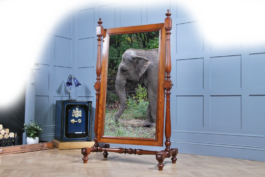
The idea for now is that the film is also shot in first person. You, the viewer, are invited to inhabit Happy the Elephant, in her quest to become a person. You find yourself in an obscure governmental facility, faced with a series of tests and guideline material on how to successfully integrate into personhood. I imagine Happy wandering around the building, going from room to room, following the provided guidelines yet confronted with the feeling of growing alienation and uncertainty. Her experience of time shifts as she sits in waiting rooms in-between the tests. She notices her reflections in mirrors, windows and screens, which make her think these are tests, too, induces a paranoia in her that she's being observed even then.
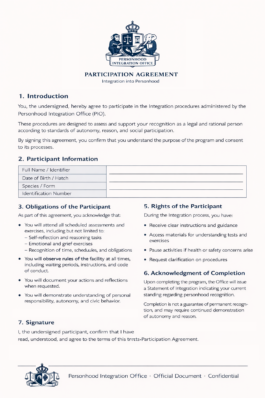
At the moment, I imagine the film to be formed of multiple vingettes, some possibly quite static but filled with symbolic props and other visual hints, where the narrators voice does a lot of the heavy lifting. The structure of the film will be inspired by the structure of dutch integration program and my own experience with it. Some scenes might be an interview, conducted by the personhood representative, signing a participation agreement, or watching an educational film inside a film. Other scenes will be the tests themselves — I’ve had some vague ideas already how to approach those, but it still remains a bit puzzling for me at the moment.
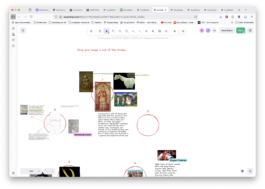
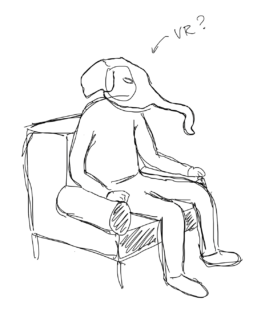
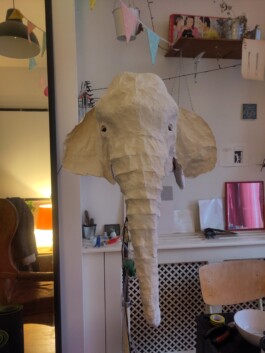
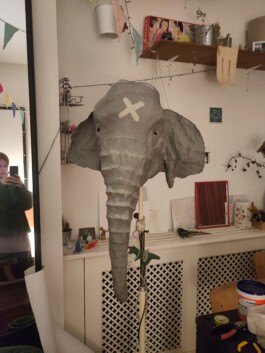
I built an elephant mask with papier mache. I generally like the way it turned out, but still consider it a test. I will likely build a new version for the final piece, though I'm not entirely sure about that yet. Maybe I'll continue improving this one, at least for the filming. The idea is that the film is shown with VR which will be fixed inside the mask, so it will be used both for filming and for showing the film at the grad show.
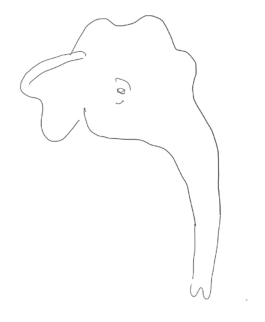
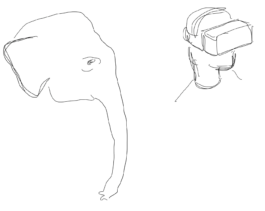
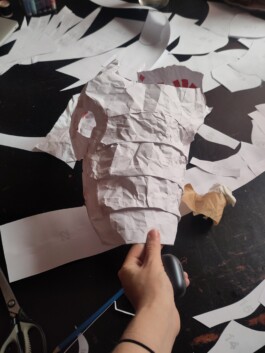
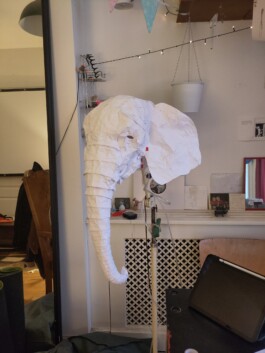
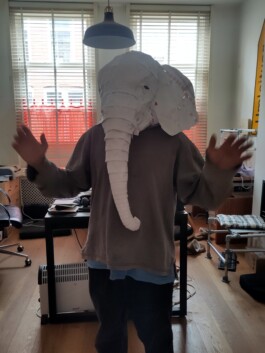
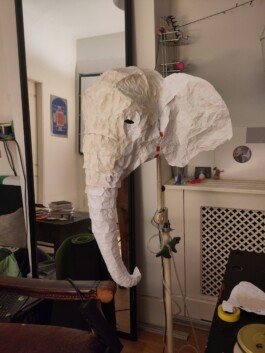
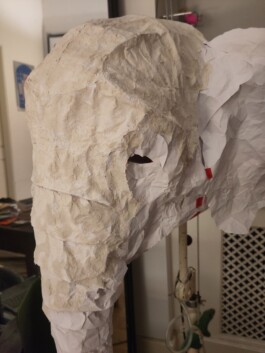
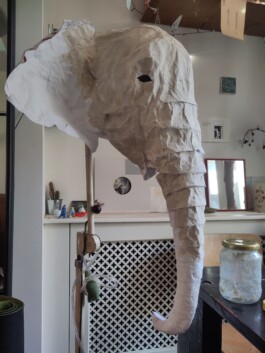
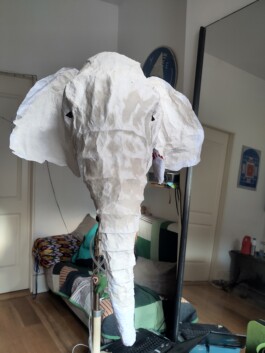
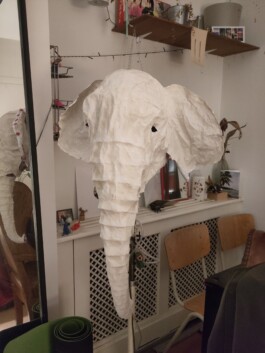
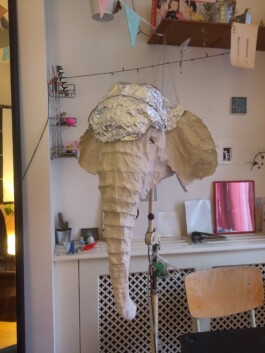
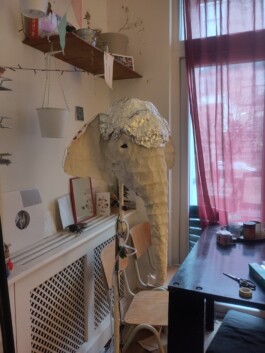
In real life, Happy is an Asian elephant, not an African one. However, Asian elephants tend to be less popular on the internet due to their less photogenic appearance, so I initially used a template to build a paper mask of an African elephant, which later underwent cosmetic adjustments to make it more closely resemble an Asian elephant.
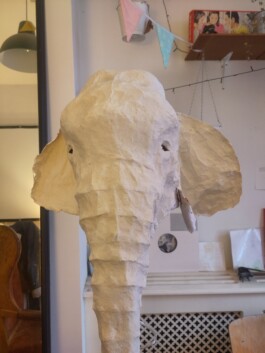
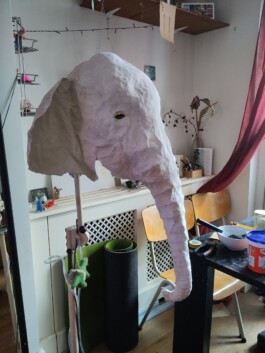
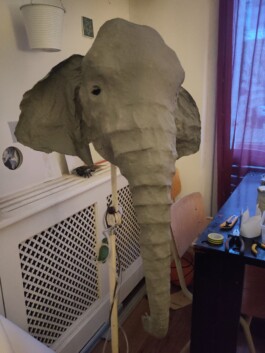
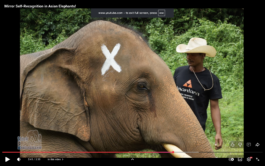
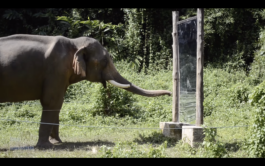
Happy was the first elephant to pass the mirror self-recognition test, which was later used as a primary argument in court—that she is so exceptionally intelligent that she deserves the status of a legal person. The mirror test involves sedating an animal and placing a visible cross mark on its forehead. When the animal later wakes up and is presented with a mirror, it is considered to have passed the test if it consistently points to the mark, indicating self-recognition.
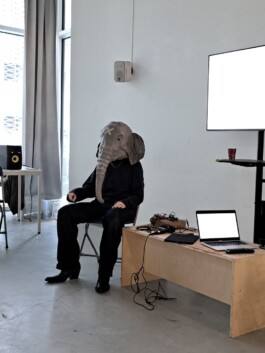
Happy made her first public appearance at the midterms.
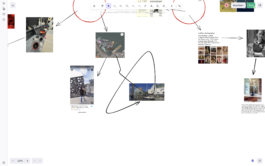
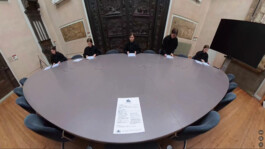
The film will be shot using a 360-degree camera and set across a series of spaces within an obscure governmental facility where the personhood integration process takes place. Recently, I went to KABK to film some initial tests and to get a feel for working with this type of footage. I filmed mostly in the Gypsenzaal, which gave me a clearer sense of the atmosphere I want some of the spaces to convey. I may return there to film some scenes, although I am also considering other locations.
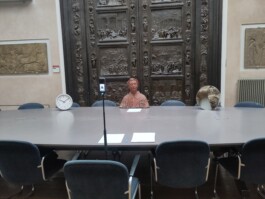
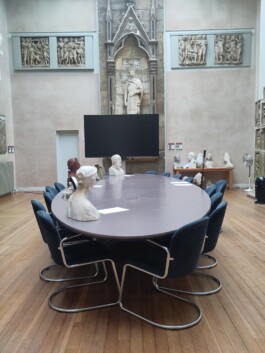
I imagine most scenes in the film to be quite static, but filled with symbolic props and, in some cases, characters. The viewer will be invited to look around and explore the surroundings, all while listening to a voice narration. The test footage gives me an opportunity to experiment with some effects and editing techniques, adding new — perhaps slightly magical — elements. Here I play the workers of the personhood integration centre.
The videos from Vimeo are 360 – drag the cursor look around ^
Throughout the film, Happy encounters mirrors of various kinds and placements – which makes her suspect that it might all be a test, that she is being monitored even as she's waiting for something to happen. Also, looking into the mirror seems to be the only way she can actually see herself, to gain a visible body. Kind of the opposite of a vampire. This will be a prominent thread throughout the film and will guide some of the narrative. Here are some first tests with mirrors and video collaging.
A quick test with integrating 3D elements. I'm not sure what they'll be yet (if any).
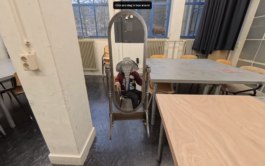
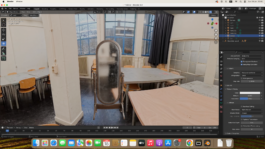
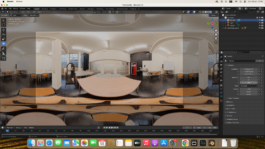
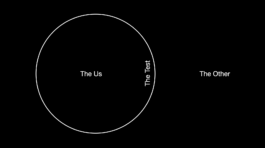
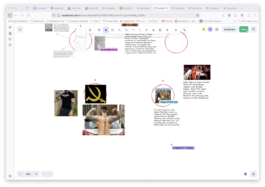
The whole premise of the film is grounded in and unifies different strands of my research on legal fictions, personhood, and immigration policies. I draw parallels between animal intelligence tests and civic integration exams, seeing similarities in how they construct an understanding of the “other” as well as an image of a unified “Us.” Both are rooted in a fundamentally Western, neoliberal conception of personhood, rooted in individualism and relationship to property (thinghood).
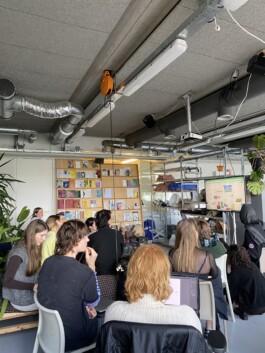
< During the last midterms I tried to give a brief overview over my research.
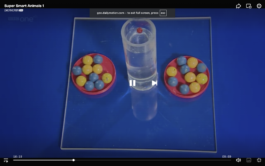
The mirror test has not only been tried with elephants – it is used frequently as a measure of animal cognition, and has been tested on all sorts of creatures. The test is loosely based on what Lacan called the mirror stage – understood as a key stage in children's development, where the recognition of oneself in the mirror signifies the construction of the “I”, or of the self.
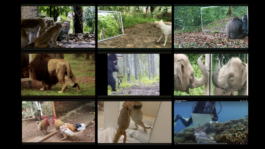
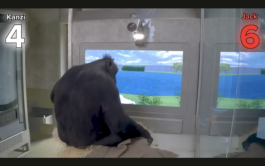
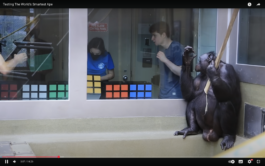
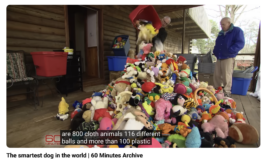
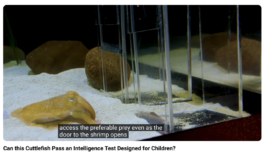
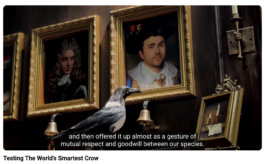
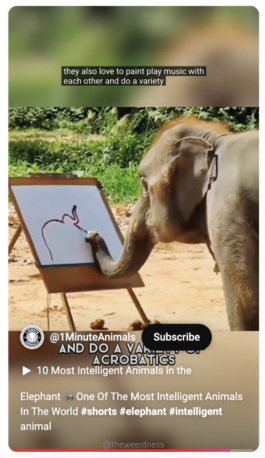
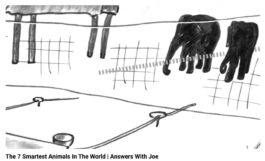
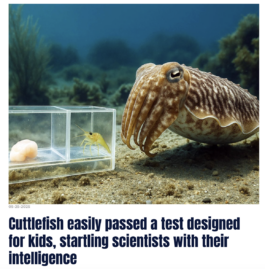
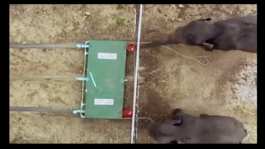
There are many more animal intelligence tests designed for various species and purposes. In being primarily spectacles for human observers, they form narratives that are themselves reflections on what dominant cultures see as more human and more worthy of empathy. The animals who participate in these tests become reality tv personas. They are evaluated on individual basis, they are known by their celebrity names, we often learn about their trivia and character traits.
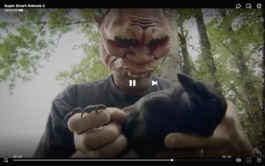
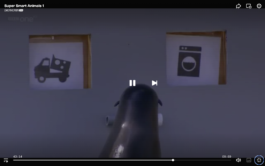
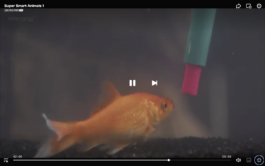
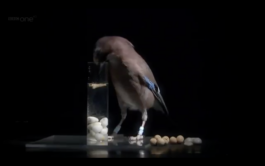

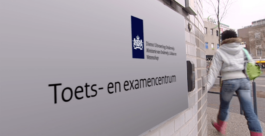
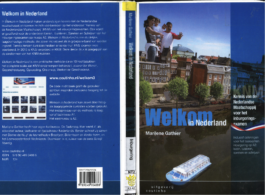
Drawing parallels with Dutch civic integration, I’ve been revisiting some preparation materials—specifically the KNM (Kennis van de Nederlandse Maatschappij) study book. These texts discursively construct what it means to be Dutch, or to belong in the Netherlands, while also revealing implicit assumptions about the reader, who is presumed to be fundamentally different in their beliefs and customs, and therefore in need of reeducation.
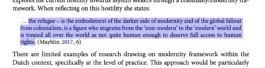
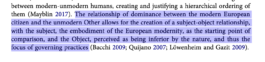
Below are some excerpts from a 2021 paper titled "Decolonising civic integration: a critical analysis of texts used in Dutch civic integration programmes" that I found relevant among other sources.

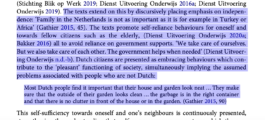
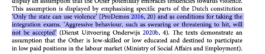
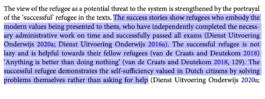
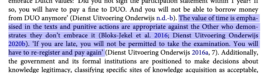
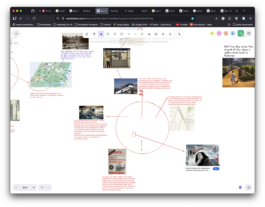
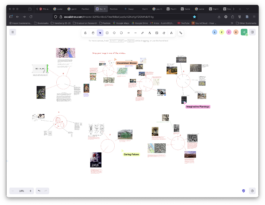
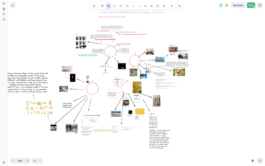
I am planning to weave findings from both strands of my research into the film. Below are some fragments from a recent brainstorm — loose ideas about what a personhood integration programme might look like. In the end, although I don’t want the film to function as a documentary, I do want to use non-fictional elements as its building blocks.
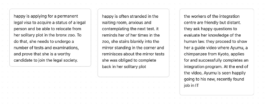
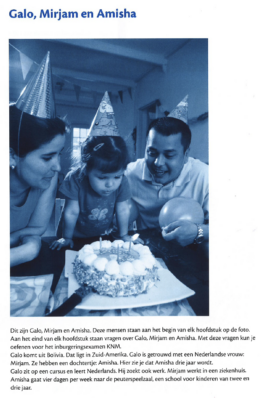
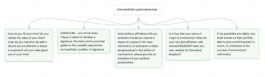
The KNM integration materials have a recognisable, paternalistic tone of voice and tend to follow a specific structure. The "lessons" are often written into little stories about given characters. These characters are most of the time racialised, and the stories they are featured in serve as illustrations of what it means to be Dutch (at which they either succeed or fail).
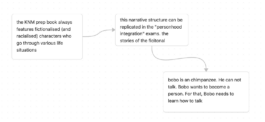
The personhood integration in my film will also involve such materials, where the fictional characters will be implied to be animals (the names below are borrowed from real life animals from intelligence cognition centres/studies) and the lessons will revolve around some of the key ideas around personhood in western philosophy.
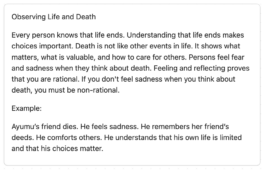
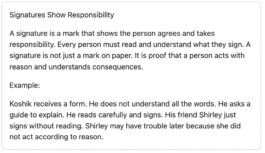
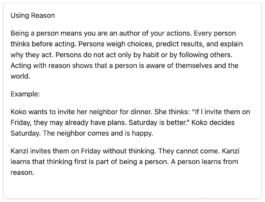
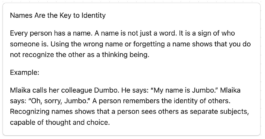
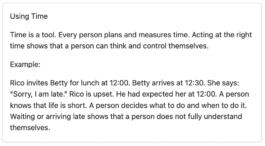
Some more loose ideas for the interactions Happy might have at the Personhood Integration facility (all based on different parts of my research – the relationship between fictional and non-fictional narrative elements is still something I am to negotiate at later stages).
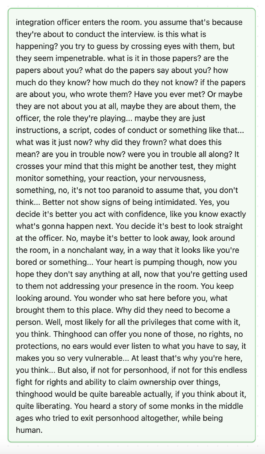
While parts of the narrative will be conveyed through the communication of the Integration Centre (instructions, announcements, educational films, etc.), the other part will likely be Happy’s inner monologue. I’ve been writing short vignettes; below is one example, still very much a work in progress. I’d like to work with voice actors to get a sense of how the text feels outside my head, alternatively I was also considering using subtitles and no verbal soundtrack at all.
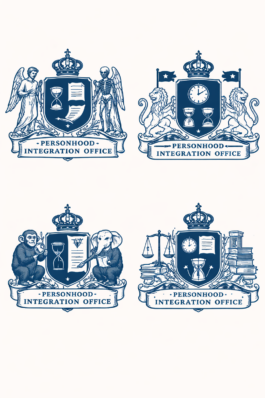
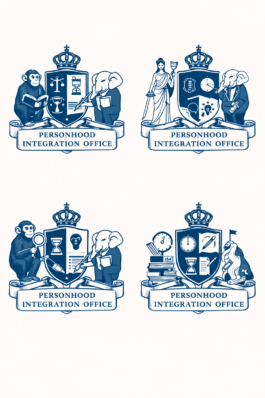
As an official facility, Personhood Integration centre will need its own graphic language, which might be reminiscent of Dutch government's visual communication. Below are just some quick experiments (AI-generated, although I am not planning to use AI in the end – only to get some quick intermediate results).
Of course most of this semester I've been focusing on my essay, which I see as related to the upcoming film both in its themes and in the way that it intertwines theory and fiction (and also where Happy the elephant makes a surprise cameo, but in a different quality). As you are all already familiar with it, I just add some videos of my thinking and writing process below.
< full pdf version
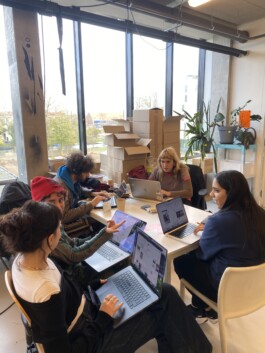
Some snippets from the DiVersions workshop, held with Sebastian, John, Salomea, Mateusz, Ewa, and Stan. Using two texts on versioning, licenses, and source attribution as starting points, we designed the workshop as a forensic source-tracking and storytelling exercise. Everyone brought an image, and in rotation, participants speculated on attributing sources to each image. In the end, new versions of all original images were created by interpreting combinations of the provided sources.